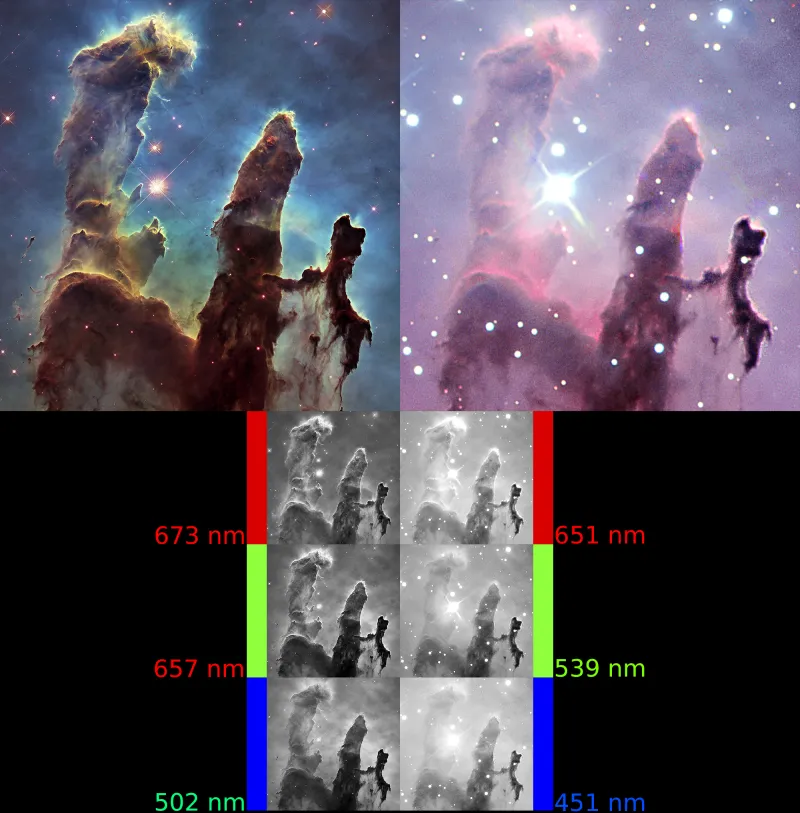
Exploring the Colors of the Hubble Palette
The Hubble Palette is one of the most iconic processing techniques in astrophotography. Instead of showing nebulae in their natural visible colors, it uses narrowband data to create a unique false-color image that reveals structures and details hidden within emission regions.
The technique is based on combining three main emission filters: Sulfur II (SII), Hydrogen Alpha (Ha), and Oxygen III (OIII). Each channel is assigned a different color, creating the famous golden, green, and blue tones often seen in professional space images.
The main advantage of the Hubble Palette is the ability to separate different gases inside a nebula. Structures that may look similar in a regular RGB image can become much more visible, allowing astrophotographers to highlight fine details, textures, and areas of active star formation.
My workflow usually begins by capturing separate narrowband images and calibrating each channel individually. After stacking and cleaning the data, I combine the channels and carefully adjust the colors, contrast, and saturation to create a balanced final image.
Creating a good Hubble Palette image is not only about combining colors — it is about finding the right balance between scientific detail and visual beauty. Too much processing can make the image look unnatural, while careful adjustments can reveal incredible structures hidden inside the nebula.
The Hubble Palette opens a completely different way of viewing the universe. It transforms invisible wavelengths of light into a colorful representation of the processes happening in distant clouds of gas and dust.
Behind the Image
🔹How the Hubble Palette Is Created
🔹Turning Invisible Light into Color
🔹Working with Narrowband Filters
🔹My Approach to Color Processing
🔹Revealing the Hidden Universe